After 16 years in power, Viktor Orbán acknowledges a decisive loss to opposition leader Peter Magyar, whose Tisza movement is...
Read More
International-News
Middle East: Risk of Imminent US Strike on Iran
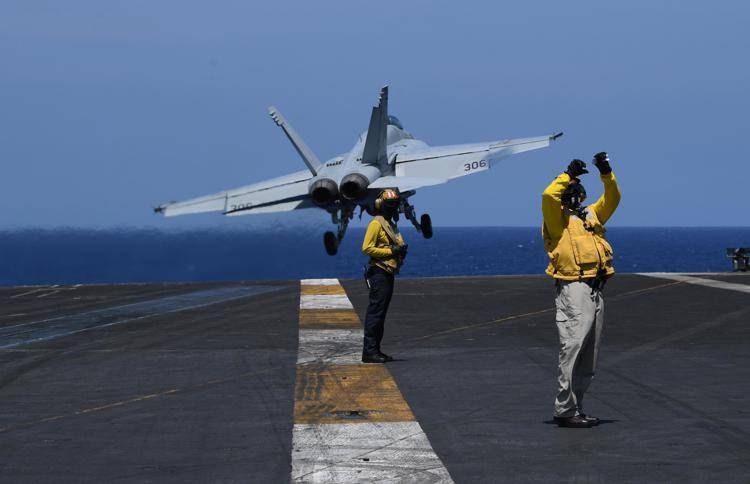
In recent days, tensions between the United States and Iran have escalated, with the US increasing military presence and Iran demonstrating its strength in the Strait of Hormuz. Military options include targeted strikes, broader air campaigns, and regime destabilization scenarios
Crisis Acceleration and Converging Signals – Over the past 48 hours, the US-Iran crisis has accelerated significantly. Contributing factors include a high-level meeting at the White House with Donald Trump, the rapid deployment of US military assets in the region, and Iranian demonstrations of force in the Strait of Hormuz. The possibility of a “short-term” strike is no longer rhetorical but an operational option on the table.
Available information indicates that the White House is evaluating military options while keeping diplomatic channels open. The administration is awaiting a written proposal from Iran following talks in Geneva, noting limited progress and remaining gaps. Meanwhile, the military buildup is expected to be fully deployed in the near term to make the threat credible.
Red Lines and Military Pressure
Four main factors drive the crisis toward escalation:
- Incompatible Red Lines: Washington pursues ambitious objectives, including eliminating Iran’s nuclear program and halting ballistic missiles. Tehran publicly asserts its right to enrichment and considers its missile program essential for national deterrence.
- Military Pressure as Negotiation Tool: The US military buildup increases the credibility of the “deal or strike” alternative but also raises the risk of incidents, unplanned escalation, and proxy attacks.
- Hormuz as an Iranian Deterrent: Exercises and temporary closures in the Strait serve to show Iran can raise the systemic cost of the crisis, affecting market premiums and risk perception, even without fully blocking maritime traffic.
Israel Factor: Netanyahu supports ambitious objectives targeting missiles, infrastructure, and proxies. Strategic alignment with Washington increases pressure on Tehran.
Military Options
Limited Strike on Nuclear Infrastructure: Targeting sites such as Natanz, Fordow, and Isfahan with bunker-buster bombs aims to reduce nuclear capabilities and retaliatory potential. Operational challenges include redundancies, underground facilities, and material dispersion.
Broader Air Campaign: Targeting air defenses, missiles, and command-and-control assets to weaken Iran’s retaliatory capability. This campaign could last weeks and heightens the risk of escalation against US bases and allies.
Regime Decapitation and Destabilization: The riskiest scenario involves command fragmentation, potential closure of Hormuz, attacks on regional energy infrastructure, and a full-scale regional conflict.
Iranian Response and Regional Risks
Iran’s strategy is asymmetric, aiming to multiply fronts:
- Direct attacks with missiles and drones on regional bases, including US assets.
- Mobilization of proxies across Iraq, Lebanon, Syria, and Yemen.
- Disruptions in the Strait of Hormuz, affecting global energy flows.
- Cyberattacks on critical infrastructure: energy, finance, and logistics.
Gulf monarchies remain vulnerable due to dependence on electricity and desalinated water. Any strike could affect civilian infrastructure, adding political leverage for Tehran.
Market Impact and Diplomatic Window
Markets and European public opinion are closely monitoring developments: a prolonged conflict could sharply affect oil prices. Evacuation warnings from some European capitals indicate assessments of rapid escalation.
The diplomatic window remains open, awaiting an Iranian proposal that could allow a temporary freeze or technical compromise.
Realistic Scenarios
- Tactical De-escalation: Continuation of talks and military pressure without strike.
- Limited Strike and Contained Response: Targeted strikes with calibrated retaliations; high tension but no full regional war.
- Regional Escalation: Broader attacks or perceived “regime change,” multi-domain Iranian response, Strait of Hormuz leveraged, potential involvement of multiple countries.
THE LATEST NEWS

Sinner defeats Alcaraz to win Monte Carlo and claim world No. 1
12 Aprile 2026
The Italian beats the Spaniard 7-6(5), 6-3 in the final, sealing both the title and the top spot in the...
Read More

Iran Unable to Fully Reopen Strait of Hormuz Due to Naval Mines, U.S. Officials Say
11 Aprile 2026
New York Times cites Pentagon sources on technical limits; Trump pushes for reopening amid Islamabad talks with Tehran Iran would...
Read More
CDC Vaccine Report Delayed as Trump Administration Faces Criticism Over COVID Data
11 Aprile 2026
Washington Post reports postponement of study on vaccine effectiveness; Italian infectious disease expert Matteo Bassetti criticizes U.S. health leadership The...
Read More

U.S. Destroyers Cross Strait of Hormuz as Trump Announces “Clearing Operation”
11 Aprile 2026
WSJ cites sources confirming passage of two U.S. warships amid conflicting Iranian denials and renewed tensions over navigation in the...
Read More
Mojtaba Khamenei Still Active After February 28 Israeli Strike, Report Says
11 Aprile 2026
Sources cited by Reuters say Iran’s new Supreme Leader is recovering from severe injuries but continues to take part in...
Read More
(Source and photo: © AndKronos)