Pentagon plans were prepared and briefed at the highest level, but concerns over escalation, casualties and economic fallout led to...
Read More
International-News
Iran tightens control over Strait of Hormuz as traffic collapses amid war with the US
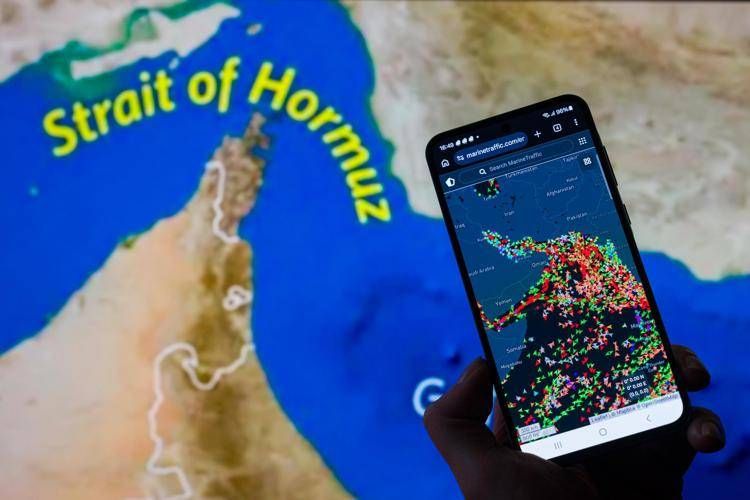
Tehran restricts access to a key global oil chokepoint while Washington prepares a possible second phase of military operations
Iran is effectively controlling access to the Strait of Hormuz after three weeks of war with the United States, severely restricting maritime traffic through one of the world’s most critical النفط routes. Despite Washington’s overwhelming military superiority, Tehran continues to dictate passage through the narrow waterway, which handles roughly 20% of global oil shipments.
Limited access and paid transit
Iranian authorities are allowing only a small number of vessels to pass through the strait under strict conditions. According to reports from the Financial Times and Lloyd’s List, between eight and nine ships have recently been authorized to transit.
In at least one case, passage reportedly required a payment of $2 million. Among the vessels that managed to cross are cargo ships from Greece, India, and Pakistan. Greek-linked shipments accounted for approximately 18% of recent transits, according to Lloyd’s List Intelligence analyst Bridget Diakun.
Ships have been rerouted along an unusual corridor near Larak Island, where they are believed to undergo Iranian inspections before receiving clearance. Additional tankers, including a group of Chinese vessels currently waiting off Abu Dhabi, may soon be granted permission to pass.
Direct coordination is underway between Tehran and several governments, including China, India, Pakistan, and Malaysia, often involving Iran’s Revolutionary Guard Corps, according to Lloyd’s List analysts.
Traffic collapse and economic impact
Shipping activity through the strait has plummeted since the conflict began on February 28. Data from energy analytics firm Kpler shows only 116 transits between March 1 and March 19, representing a 95% drop compared to peacetime levels.
Of these, 71 were oil tankers, with more than half fully loaded and heading eastward toward Asian markets. More than one-third of vessels operating in the area are currently under US, European, or British sanctions, further complicating maritime flows.
An estimated 3,200 ships are now stranded or delayed in the broader المنطقة, creating significant disruptions across global supply chains.
Strategic stakes and China’s role
The Strait of Hormuz remains a vital artery for energy exports, particularly to Asia. According to JP Morgan analysis, the majority of oil flowing through the strait is destined for Asian markets, with China as the primary buyer.
Beijing maintains strong economic ties with Tehran, importing approximately 90% of Iran’s daily oil exports—around 1.6 million barrels—according to figures reported by the Wall Street Journal. This relationship provides Iran with tens of billions of dollars in annual revenue, reinforcing its capacity to sustain pressure despite sanctions and military tensions.
Escalation risks and US response
Meanwhile, the United States appears to be preparing for a potential escalation. Military movements suggest a possible “phase two” of the operation known as Epic Fury, with amphibious ships and Marine units being deployed to the region.
Such forces could be used to secure or reopen the strait, a move that would mark a significant escalation and risk direct confrontation with Iranian forces.
What comes next
Iran’s strategy of selectively allowing maritime transit while maintaining overall control of the strait highlights its leverage in the conflict. By effectively managing the “traffic light” of global oil flows, Tehran is exerting pressure not only on Washington but also on global markets and key Asian economies.
Whether the United States will move to forcibly reopen the strait remains uncertain. What is clear is that the situation has entered a new phase, where economic warfare, maritime control, and military positioning are increasingly intertwined.
THE LATEST NEWS
The United States-Iran ceasefire memorandum: Geneva Lake possible signing
13 Giugno 2026
Negotiations continue over location and conditions as diplomatic framework advances between Washington and Tehran Lake Geneva is being considered as...
Read More
Trump Claims US–Iran Deal Reached as Markets React With Caution
11 Giugno 2026
The US president announces on Truth Social that strikes against Iran have been cancelled after an alleged agreement involving multiple...
Read More
Trump Signals Continued Military Pressure on Iran Amid Fragile Negotiations Over Nuclear Deal and Oil Assets
11 Giugno 2026
U.S. President Donald Trump reiterates threats of sustained strikes and strategic pressure on Iran while diplomatic channels remain open over...
Read More

Bill Gates Testifies in Jeffrey Epstein Inquiry, Denies Knowledge of Crimes
10 Giugno 2026
Bill Gates told the U.S. House Oversight Committee he had no awareness of Jeffrey Epstein’s criminal activity and called their...
Read More

Russia prepares for possible NATO conflict in Northern Europe
10 Giugno 2026
A joint Nordic investigation points to a structural military buildup along Russia’s northern frontier, with a potential one-to-three-year window of...
Read More
(Photo: © AndKronos)