Police say a single gunman opened fire across three homes following a domestic incident. The suspect was later shot dead...
Read More
International-News
Amnesty and genocide accusations against Israel, Tel Aviv: ‘A fabricated report’
Amnesty International denounces the ‘physical destruction’ of Palestinians in Gaza, Israel rejects the accusations and reaffirms its right to defend itself against Hamas
Israel has firmly rejected the accusations of genocide against the Palestinian population in the Gaza Strip contained in a report published by Amnesty International, calling the organisation a ‘fanatic’ and accusing it of disseminating ‘invented’ and ‘completely false’ information. In an official statement, the Israeli Foreign Ministry reiterated that Tel Aviv’s actions should be read as a legitimate defence against the unprecedented attack by Hamas on 7 October 2023, which, according to Israel, must be considered a ‘genocidal’ act.
Amnesty International’s report, which spans over three hundred pages, has raised serious international concerns. According to the organisation, Israel has allegedly engaged in a series of acts aimed at ‘physically destroying’ Palestinians in Gaza, describing these acts as ongoing genocide. Amnesty claimed to have gathered sufficient evidence to support its accusation, analysing a wide range of documents, satellite images and interviews with victims and eyewitnesses.
Amnesty’s document details acts that the organisation claims violate the Geneva Convention and aim to ‘physically destroy’ the Palestinian population of Gaza. Among the acts indicted are murder, serious injuries, the creation of living conditions that lead to death, and the denial of life-saving humanitarian aid. The organisation also emphasised that genocide does not have to be successful, but that it is sufficient that the acts are carried out with the intent to destroy a protected group. Amnesty also recalled that international jurisprudence defines genocide as the intent to destroy, in whole or in part, a national, ethnic, racial or religious group, even if it is not carried out successfully.
According to Agnès Callamard, Secretary General of Amnesty, Israel has treated the Palestinians of Gaza as a ‘subhuman’ group, violating their human rights and causing systematic destruction of their lives. Callamard also pointed out that Israel’s conduct in Gaza is part of a broader context of ‘illegal military occupation’ and ‘apartheid’, and that Israeli actions have continued despite the international community’s knowledge of the ongoing atrocities.
In response, Israel firmly rejected the accusations, claiming that its operations in Gaza are justified as part of a military effort to eradicate Hamas, a group that Tel Aviv considers a terrorist organisation. Israel also argued that the intent to protect its security does not, in its view, justify accusations of genocide. It added that the existence of Hamas fighters among Gaza civilians does not absolve Israel of its obligation to take measures to protect civilians and minimise collateral damage.
Amnesty International also carefully analysed public statements by Israeli officials, finding that military operations were often announced by senior Israeli officials, which could reinforce the intent to carry out violent acts against the Palestinian population. The organisation went on to criticise Israel’s lack of action to protect civilians and ensure humanitarian access, complaining that Palestinians in Gaza were forced to live in inadequate conditions, with no possibility of escaping the shelling.
Amnesty concluded that although Israel justifies its actions as necessary for security, the reality of its operations in Gaza shows a clear intent to physically destroy Palestinians. Despite the serious violations, Callamard pointed to a failure of the international community, accusing governments of not putting sufficient pressure on Israel to stop the atrocities. The organisation therefore urged world powers to stop ignoring violations of international law and take concrete measures to stop what it considers to be ongoing genocide.
THE LATEST NEWS

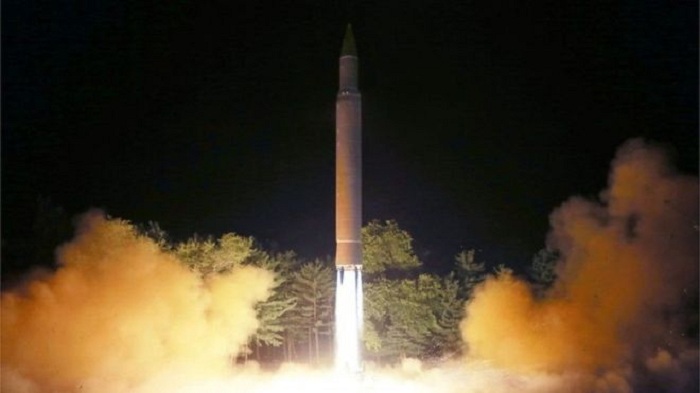
North Korea Fires Unidentified Ballistic Missile, Seoul and Tokyo Say
19 Aprile 2026
Japan and South Korea report a suspected ballistic missile launch as Pyongyang continues a series of weapons tests under Kim...
Read More
Donald Trump Approval Rating Falls to 37% in NBC News Poll
19 Aprile 2026
A new NBC News survey shows declining support for the U.S. president, with sharp criticism over the economy and his...
Read More

Several Injured in Iowa City Shooting Near University Campus Area
19 Aprile 2026
Police say multiple people were taken to hospital after gunfire erupted during a night incident near the University of Iowa...
Read More

UK security clearance failure for Mandelson triggers top resignation
17 Aprile 2026
Sir Olly Robbins steps down after Keir Starmer was not informed that Lord Mandelson failed top-level security vetting required for...
Read More

Israel-Hezbollah ceasefire, Trump announces 10-day truce taking effect at midnight
16 Aprile 2026
U.S. president says agreement follows talks with Netanyahu and Aoun, with White House meetings planned U.S. President Donald Trump announced...
Read More